' MATCH THREAD: SERBIA v WALES ' UPDATED DAILY
Wed Jun 07, 2017 11:29 pm
SERBIA V WALES
World Cup Qualifiers First round
Sunday 11 June, 19:45
Red Star Stadium
Over 2,500 Welsh Football Fans are travelling
Latest News
The qualifying clash in European Group D kicks off at 1945 BST in Belgrade, live on Sky Sports 1 and S4C.
Wales boss Chris Coleman has selected a 23-man squad for Sunday's World Cup qualifier against Serbia in Belgrade.
Robson Kanu is out.
Gareth Bale and Neil Taylor are ruled out through suspension.
There are five uncapped players included in the squad, Joe Walsh (Milton Keynes Dons), Tom Lockyer (Bristol Rovers), Gethin Jones (Everton), Lee Evans (Wolverhampton Wanderers) and Ben Woodburn (Liverpool).
Wales Squad
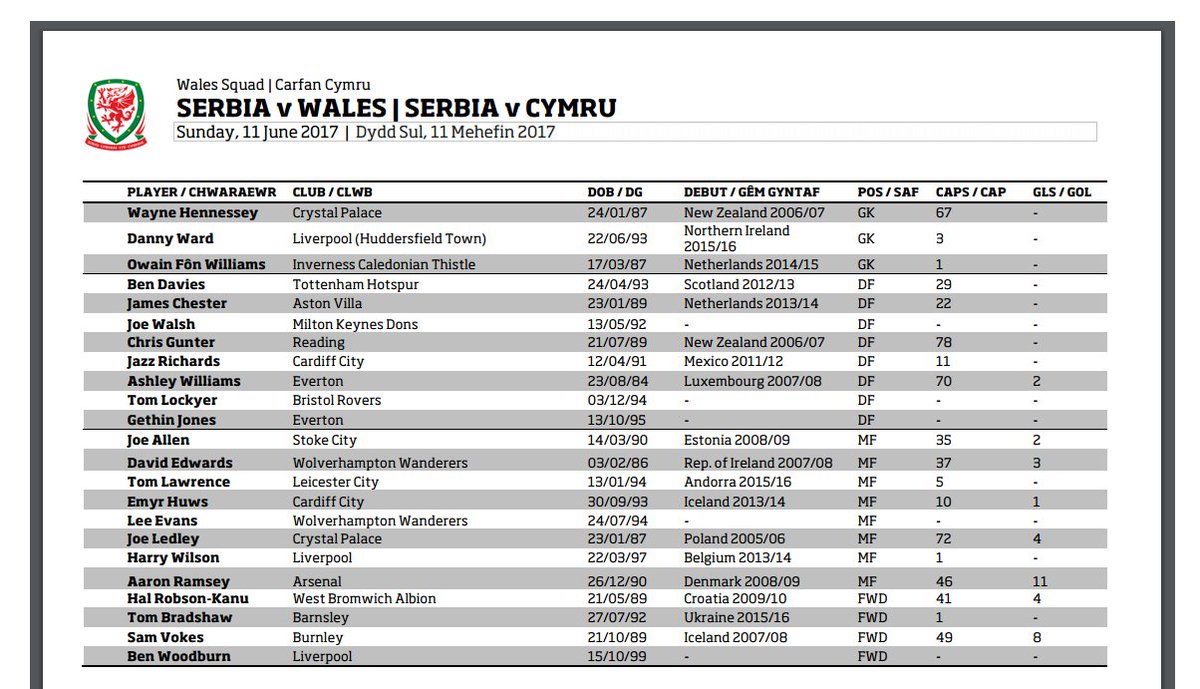
Goalkeepers: Wayne Hennessey (Crystal Palace), Danny Ward (Liverpool), Owain Fôn Williams (Inverness Caledonian Thistle)
Defenders: Ashley Williams (Everton), Chris Gunter (Reading), James Chester (Aston Villa), Ben Davies (Tottenham Hotspur), Jazz Richards (Cardiff City), Joe Walsh (MK Dons), Tom Lockyer (Bristol Rovers), Gethin Jones (Everton)
Midfielders: Aaron Ramsey (Arsenal), Joe Ledley (Crystal Palace), Emyr Huws (Cardiff City), Dave Edwards (Wolverhampton Wanderers), Joe Allen (Stoke City), Lee Evans (Wolverhampton Wanderers), Harry Wilson (Liverpool)
Forwards: Tom Lawrence (Leicester City), Hal Robson-Kanu (West Bromwich Albion), Sam Vokes (Burnley), Tom Bradshaw (Barnsley), Ben Woodburn (Liverpool)
Serbia

FIFA World Cup™ finals history
Serbia played their first official international match as an independent nation on 16 August 2006, beating Czech Republic 3-1 away. Before then, they had been part of two countries that now no longer participate: Yugoslavia and Serbia and Montenegro. Serbia's inaugural independent FIFA World Cup qualifying campaign was for South Africa 2010, and they surprisingly booked their ticket to the tournament after emerging from a group with France, Austria, Lithuania, Romania and Faroe Islands. However, once there, the Beli Orlovi (White Eagles) were unable to make it past the group stage. Serbia failed to reach Brazil 2014 after posting four wins, two draws and four defeats in a qualifying group with Belgium, Croatia, Scotland, Wales and Macedonia.
The team
Much like their predecessors, the current Serbia side are among Europe’s best in terms of technique, and the squad boasts a number of first-rate players, the majority of whom play in some of the continent’s top leagues in England, Italy and Germany. For example, Branislav Ivanovic is not only one of Serbia’s most experienced players, he is also one of the best full-backs in the Premier League. Aleksandar Kolarov and Matija Nastasic help him form a solid rearguard, while Filip Djuricic and Aleksandar Mitrovic are dangerous up front.
The coach
Slavoljub Muslin was named Serbia head coach after departure of Radovan Ćurčić. Though this is his first coaching appointment in international football, the former Red Star Belgrade and Lille defender has had a long coaching career at the club level, having managed clubs in France, Morocco, Bulgaria, Ukraine, Belgium, Russia, Belarus and Cyprus. In his native Serbia, Muslin led Red Star Belgrade to three domestic league titles.
The stat
11 – The number of World Cup tournaments Serbia have participated in. Between 1930 and 1998 Yugoslavia took part in nine finals; Serbia and Montenegro played at Germany 2006 and four years later Serbia reached South Africa.
The former stars
Stjepan Bobek, Dragan Dzajic, Branko Zebec, Mateja Kezman, Sinisa Mihajlovic, Savo Milosevic, Dejan Stankovic
Wales

FIFA World Cup finals history
Wales have only appeared at the finals once, in 1958 when they were led by the great John Charles. They reached the quarter-finals after a 2-1 win over returning runners-up Hungary, with a solitary Pele goal then sending them home. They have struggled in qualifying since, coming close in bids to reach 1982 and 1986 but lost out to Czechoslovakia and Scotland respectively on goal difference.
The team
Not lacking in individual talent, The Dragons are blessed with the likes of Gareth Bale and Aaron Ramsey, while Joe Ledley and Joe Allen help make up a dynamic midfield. Behind them, the likes of English Premier League regulars Ben Davies, James Collins and captain Ashley Williams feature in a solid backline.
The coach
Though still a manager in the early stages of his coaching career, aged 44, Chris Coleman already has 12 years’ experience in the hot seat. Since taking charge of the nation he represented 36 times as a player in 2012, there have been promising signs that they could make their return to the World Cup.
The stat
35 – The number of days after Gareth Bale's 17th birthday when he became Wales' youngest-ever goal-scorer.
The former stars
John Charles, Ian Rush, Gary Speed, Ryan Giggs, Ivor Allchurch, Neville Southall
Qualifying Group & Fixtures
GROUP D
2016
September 5 Wales 4-0 Moldova
October 6 Austria 2 - 2 Wales
October 9 Wales 1 - 1 Georgia
November 12 Wales 1 - 1 Serbia
2017
March 24 Republic of Ireland 0 - 0 Wales
June 11: (a) v Serbia
September 2: (h) v Austria
September 5: (a) v Moldova
October 6: (a) v Georgia
October 9: (h) v Republic of Ireland
Previous Meetings
11 Sep 2012 Serbia v Wales L 6-1 FIFA World Cup
10 Sep 2013 Wales v Serbia L 0-3 FIFA World Cup
12 Nov 2016 Wales v Serbia D 1-1 FIFA World Cup
Stadion Rajko Mitic

Key facts
Red Star Stadium or El stadio de Marakana is a multi-functional football stadium located in Serbia’s capital city of Belgrade. Used predominantly for the football matches of Red Star Belgrade who are the most successful club in Serbia, the ground has a 55,538 capacity and was most recently renovated in 2008 when new floodlights and pitch were installed.
History and description
The site on which today’s Stadion Rajko Mitić sits has been used to host football throughout the 20th century, with the first stadium opening way back in 1927. Home to SK Jugoslavija, the stadium was capable of accommodating 30,000 supporters, and featured an athletics track around the perimeter of the pitch. When the club were disbanded after the Second World War ownership of the ground was transferred to the newly formed Red Star Belgrade.
By the 1960s the stadium was slowly developing into a state of disrepair, and on 27th December 1959 Red Star played their last match at the original ground against FK Novi Sad. Construction began on the new Marakan almost immediately, and three years later the stadium was inaugurated on 1st September 1963 with a Yugoslav First League game against NK Rijeka.
Almost finished, the welcome back match attracted a crowd of 55,000, however by the following season the capacity would be increased to a whopping 110,000 earning it the informal nickname of “Marakana” after Brazil’s Estádio Maracanã. The record attendance which was set on 23rd April 1975 saw 117,000 supporters cram into the stadium to see Red Star take on Ferencváros in the Cup Winners Cup semi-final.
Since the 1980s every passing renovation has seen the Marakana’s capacity decrease as Red Star Belgrade adhere to the latest safety regulations outlined by UEFA. The conversion to all-seating in the mid 1990s for example saw the capacity diminish by just over half to 60,000 – a figure which is still more than impressive by itself.
Tickets
The match is now sold out
Match Odds
Wales 21/5
Draw 13/5
Serbia 7/10
Guess The Score
Post your predictions below
World Cup Qualifiers First round
Sunday 11 June, 19:45
Red Star Stadium
Over 2,500 Welsh Football Fans are travelling
Latest News
The qualifying clash in European Group D kicks off at 1945 BST in Belgrade, live on Sky Sports 1 and S4C.
Wales boss Chris Coleman has selected a 23-man squad for Sunday's World Cup qualifier against Serbia in Belgrade.
Robson Kanu is out.
Gareth Bale and Neil Taylor are ruled out through suspension.
There are five uncapped players included in the squad, Joe Walsh (Milton Keynes Dons), Tom Lockyer (Bristol Rovers), Gethin Jones (Everton), Lee Evans (Wolverhampton Wanderers) and Ben Woodburn (Liverpool).
Wales Squad
Goalkeepers: Wayne Hennessey (Crystal Palace), Danny Ward (Liverpool), Owain Fôn Williams (Inverness Caledonian Thistle)
Defenders: Ashley Williams (Everton), Chris Gunter (Reading), James Chester (Aston Villa), Ben Davies (Tottenham Hotspur), Jazz Richards (Cardiff City), Joe Walsh (MK Dons), Tom Lockyer (Bristol Rovers), Gethin Jones (Everton)
Midfielders: Aaron Ramsey (Arsenal), Joe Ledley (Crystal Palace), Emyr Huws (Cardiff City), Dave Edwards (Wolverhampton Wanderers), Joe Allen (Stoke City), Lee Evans (Wolverhampton Wanderers), Harry Wilson (Liverpool)
Forwards: Tom Lawrence (Leicester City), Hal Robson-Kanu (West Bromwich Albion), Sam Vokes (Burnley), Tom Bradshaw (Barnsley), Ben Woodburn (Liverpool)
Serbia
FIFA World Cup™ finals history
Serbia played their first official international match as an independent nation on 16 August 2006, beating Czech Republic 3-1 away. Before then, they had been part of two countries that now no longer participate: Yugoslavia and Serbia and Montenegro. Serbia's inaugural independent FIFA World Cup qualifying campaign was for South Africa 2010, and they surprisingly booked their ticket to the tournament after emerging from a group with France, Austria, Lithuania, Romania and Faroe Islands. However, once there, the Beli Orlovi (White Eagles) were unable to make it past the group stage. Serbia failed to reach Brazil 2014 after posting four wins, two draws and four defeats in a qualifying group with Belgium, Croatia, Scotland, Wales and Macedonia.
The team
Much like their predecessors, the current Serbia side are among Europe’s best in terms of technique, and the squad boasts a number of first-rate players, the majority of whom play in some of the continent’s top leagues in England, Italy and Germany. For example, Branislav Ivanovic is not only one of Serbia’s most experienced players, he is also one of the best full-backs in the Premier League. Aleksandar Kolarov and Matija Nastasic help him form a solid rearguard, while Filip Djuricic and Aleksandar Mitrovic are dangerous up front.
The coach
Slavoljub Muslin was named Serbia head coach after departure of Radovan Ćurčić. Though this is his first coaching appointment in international football, the former Red Star Belgrade and Lille defender has had a long coaching career at the club level, having managed clubs in France, Morocco, Bulgaria, Ukraine, Belgium, Russia, Belarus and Cyprus. In his native Serbia, Muslin led Red Star Belgrade to three domestic league titles.
The stat
11 – The number of World Cup tournaments Serbia have participated in. Between 1930 and 1998 Yugoslavia took part in nine finals; Serbia and Montenegro played at Germany 2006 and four years later Serbia reached South Africa.
The former stars
Stjepan Bobek, Dragan Dzajic, Branko Zebec, Mateja Kezman, Sinisa Mihajlovic, Savo Milosevic, Dejan Stankovic
Wales
FIFA World Cup finals history
Wales have only appeared at the finals once, in 1958 when they were led by the great John Charles. They reached the quarter-finals after a 2-1 win over returning runners-up Hungary, with a solitary Pele goal then sending them home. They have struggled in qualifying since, coming close in bids to reach 1982 and 1986 but lost out to Czechoslovakia and Scotland respectively on goal difference.
The team
Not lacking in individual talent, The Dragons are blessed with the likes of Gareth Bale and Aaron Ramsey, while Joe Ledley and Joe Allen help make up a dynamic midfield. Behind them, the likes of English Premier League regulars Ben Davies, James Collins and captain Ashley Williams feature in a solid backline.
The coach
Though still a manager in the early stages of his coaching career, aged 44, Chris Coleman already has 12 years’ experience in the hot seat. Since taking charge of the nation he represented 36 times as a player in 2012, there have been promising signs that they could make their return to the World Cup.
The stat
35 – The number of days after Gareth Bale's 17th birthday when he became Wales' youngest-ever goal-scorer.
The former stars
John Charles, Ian Rush, Gary Speed, Ryan Giggs, Ivor Allchurch, Neville Southall
Qualifying Group & Fixtures
GROUP D
2016
September 5 Wales 4-0 Moldova
October 6 Austria 2 - 2 Wales
October 9 Wales 1 - 1 Georgia
November 12 Wales 1 - 1 Serbia
2017
March 24 Republic of Ireland 0 - 0 Wales
June 11: (a) v Serbia
September 2: (h) v Austria
September 5: (a) v Moldova
October 6: (a) v Georgia
October 9: (h) v Republic of Ireland
Previous Meetings
11 Sep 2012 Serbia v Wales L 6-1 FIFA World Cup
10 Sep 2013 Wales v Serbia L 0-3 FIFA World Cup
12 Nov 2016 Wales v Serbia D 1-1 FIFA World Cup
Stadion Rajko Mitic
Key facts
Red Star Stadium or El stadio de Marakana is a multi-functional football stadium located in Serbia’s capital city of Belgrade. Used predominantly for the football matches of Red Star Belgrade who are the most successful club in Serbia, the ground has a 55,538 capacity and was most recently renovated in 2008 when new floodlights and pitch were installed.
History and description
The site on which today’s Stadion Rajko Mitić sits has been used to host football throughout the 20th century, with the first stadium opening way back in 1927. Home to SK Jugoslavija, the stadium was capable of accommodating 30,000 supporters, and featured an athletics track around the perimeter of the pitch. When the club were disbanded after the Second World War ownership of the ground was transferred to the newly formed Red Star Belgrade.
By the 1960s the stadium was slowly developing into a state of disrepair, and on 27th December 1959 Red Star played their last match at the original ground against FK Novi Sad. Construction began on the new Marakan almost immediately, and three years later the stadium was inaugurated on 1st September 1963 with a Yugoslav First League game against NK Rijeka.
Almost finished, the welcome back match attracted a crowd of 55,000, however by the following season the capacity would be increased to a whopping 110,000 earning it the informal nickname of “Marakana” after Brazil’s Estádio Maracanã. The record attendance which was set on 23rd April 1975 saw 117,000 supporters cram into the stadium to see Red Star take on Ferencváros in the Cup Winners Cup semi-final.
Since the 1980s every passing renovation has seen the Marakana’s capacity decrease as Red Star Belgrade adhere to the latest safety regulations outlined by UEFA. The conversion to all-seating in the mid 1990s for example saw the capacity diminish by just over half to 60,000 – a figure which is still more than impressive by itself.
Tickets
The match is now sold out
Match Odds
Wales 21/5
Draw 13/5
Serbia 7/10
Guess The Score
Post your predictions below
Re: ' GUESS THE SCORE: SERBIA v WALES' UPDATED DAILY
Thu Jun 08, 2017 5:59 am
4-0 Serbia
Re: ' GUESS THE SCORE: SERBIA v WALES' UPDATED DAILY
Thu Jun 08, 2017 6:37 am
0-1 Wales score early in second half and to hang on to lead
Re: ' GUESS THE SCORE: SERBIA v WALES' UPDATED DAILY
Thu Jun 08, 2017 7:39 am
I can only see a Serbia win unfortunately, 3-0.
Re: ' GUESS THE SCORE: SERBIA v WALES' UPDATED DAILY
Thu Jun 08, 2017 8:21 am
Serbia 1 - 0 Wales
Re: ' GUESS THE SCORE: SERBIA v WALES' UPDATED DAILY
Thu Jun 08, 2017 8:40 am
The game that starts to change the table,1-2 to Wales
Re: ' GUESS THE SCORE: SERBIA v WALES' UPDATED DAILY
Thu Jun 08, 2017 9:26 am
Steve Zodiak wrote:I can only see a Serbia win unfortunately, 3-0.
Yes, I agree. I just don't think Coleman has got his tactics right in this campaign so far and I also think the players have admitted themselves that after the highs of Euro 2016 that it's been difficult to get the motivation levels that high for these qualifiers.
I'm interested to see how we do without Bale. Usually, we struggle but he's not been on it for us this campaign so far. Not to his usual standards anyway. At least we have the likes of Williams, Davies, Ramsey, Allen, and Vokes available. I wasn't impressed by Serbia at all when we played them and I'm still reeling after we failed to win that game. However, they are notoriously difficult to beat at home. I'd take a draw. It would mean we basically have to win all of our remaining matches. A defeat would mean our campaign is realistically all but over. A win would be euphoric and put us back on track. I just can't see past a 1-0 or 2-0 loss.
Re: ' GUESS THE SCORE: SERBIA v WALES' UPDATED DAILY
Thu Jun 08, 2017 4:25 pm
Not 6-1, but a comfortable win for Serbia. We've never done well against the Yugoslavs!
Re: ' GUESS THE SCORE: SERBIA v WALES' UPDATED DAILY
Thu Jun 08, 2017 5:51 pm
Serbia 2 - 1
Going to this game, went to the 6-1 game.
Going to this game, went to the 6-1 game.
Re: ' GUESS THE SCORE: SERBIA v WALES' UPDATED DAILY
Fri Jun 09, 2017 4:15 am
The Welsh squad is starting to look thin. HRK is now out injured and a bunch of lower league players are creeping back into the squad. Not fancying us that much so 2-0 to Serbia and goodnight for our chances of top spot in the group.
Re: ' LATEST NEWS: SERBIA v WALES ' UPDATED DAILY
Fri Jun 09, 2017 5:48 am
Robson Kanu is out
Re: ' LATEST NEWS: SERBIA v WALES ' UPDATED DAILY
Fri Jun 09, 2017 9:14 am
Forever Blue wrote:Robson Kanu is out
We're doomed!
Re: ' LATEST NEWS: SERBIA v WALES ' UPDATED DAILY
Fri Jun 09, 2017 7:41 pm
Did this in a betting group at OLBG.
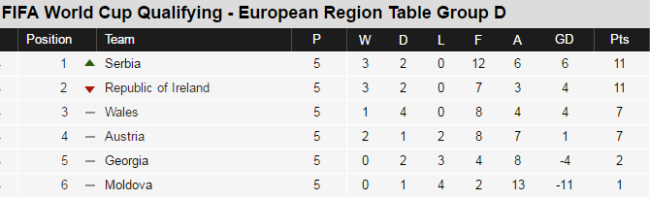
As it stands...
Serbia P5 W3 D2 L0 PTS11
Ireland P5 W3 D2 L0 PTS11
Wales P5 W1 D4 L0 PTS7
Austria P5 W2 D1 L2 PTS7
Georgia P5 W0 D2 L3 PTS2
Moldova P5 W0 D1 L4 PTS1
June 11th 2017
Moldova 0-2 Georgia
Ireland 1-1 Austria
Serbia 1-0 Wales
With Gareth Bale out through suspension, I can see Wales struggling here. Wales will be stubborn at the back as usual, but I feel the defence will be breached at some point, as without the threat of Bale at the other end of the pitch will encourage the Serbians to press forward. Against the Irish, Wales created some very good chances, which sadly fell to Taylor on two occasions, and Ramsey's tame effort was stopped. No Bale, no result. The strong Serbian side should take the points. This defeat will put Wales 7 points adrift of top side Serbia, and be Wales' first defeat since Portugal at the Euro 2016 semi-final.
Serbia P6 W4 D2 L0 PTS14
Ireland P6 W3 D3 L0 PTS12
Austria P6 W2 D2 L2 PTS8
Wales P6 W1 D4 L1 PTS7
Georgia P6 W1 D2 L3 PTS5
Moldova P6 W0 D1 L5 PTS1
September 2nd 2017
Georgia 1-1 Ireland*
Serbia 3-0 Moldova
Wales 1-0 Austria
A huge battle here for Wales, and an extremely interesting away game for the Irish in the Georgian capital, Tbilisi. Georgia in recent years have beaten Scotland at home, and have provided stern opposition to any side that travels there. The Georgian's should've beaten the Serbians here, in all honesty. After take the lead in just 5 minutes, they ended the first half 2-0 up, only for one greedy player to shoot from a tighter angle instead of squaring the ball to a teammate, who could slot home. Serbia were under pressure, and it took a penalty to get the back into the game. I think that the Irish will struggle to break down the Georgian defence. They met during the Euro 2016 qualification campaign, and Ireland were very lucky to steal a 0-1 away win thanks to a fantastic bit of play by Aidan McGeady.
Wales will face Austria at a packed Cardiff City Stadium. The two competed in a very entertaining 2-2 draw in Vienna. I feel the Welsh crowd will inspire a home victory here. The defence will hold strong, and Gareth Bale will provide a moment of magic - something he often does when Wales really need it. Both results will see the gap between Wales and Ireland cut to just three points.
Serbia P7 W5 D2 L0 PTS17
Ireland P7 W3 D4 L0 PTS13
Wales P7 W2 D4 L1 PTS10
Austria P7 W2 D2 L3 PTS8
Georgia P7 W1 D3 L3 PTS6
Moldova P7 W0 D1 L6 PTS1
September 5th 2017
Austria 2-0 Georgia
Ireland 1-1 Serbia
Moldova 0-2 Wales
Serbia P8 W5 D3 L0 PTS18
Ireland P8 W3 D5 L0 PTS14
Wales P8 W3 D4 L1 PTS13
Austria P8 W3 D2 L3 PTS11
Georgia P8 W1 D3 L4 PTS6
Moldova P8 W0 D1 L7 PTS1
October 6th 2017
Austria 1-1 Serbia
Ireland 3-0 Moldova
Georgia 1-1 Wales*
Serbia P9 W5 D4 L0 PTS19
Ireland P9 W4 D5 L0 PTS17
Wales P9 W3 D5 L1 PTS14
Austria P9 W3 D3 L3 PTS12
Georgia P9 W1 D4 L4 PTS7
Moldova P9 W0 D1 L8 PTS1
October 9th 2017
Moldova 0-2 Austria
Serbia 2-0 Georgia
Wales 2-1 Ireland
Serbia P10 W6 D4 L0 PTS22
Ireland P10 W4 D5 L1 PTS17
Wales P10 W4 D5 L1 PTS17
Austria P10 W4 D3 L3 PTS15
Georgia P10 W1 D4 L5 PTS7
Moldova P10 W0 D1 L9 PTS1
As it stands...
Serbia P5 W3 D2 L0 PTS11
Ireland P5 W3 D2 L0 PTS11
Wales P5 W1 D4 L0 PTS7
Austria P5 W2 D1 L2 PTS7
Georgia P5 W0 D2 L3 PTS2
Moldova P5 W0 D1 L4 PTS1
June 11th 2017
Moldova 0-2 Georgia
Ireland 1-1 Austria
Serbia 1-0 Wales
With Gareth Bale out through suspension, I can see Wales struggling here. Wales will be stubborn at the back as usual, but I feel the defence will be breached at some point, as without the threat of Bale at the other end of the pitch will encourage the Serbians to press forward. Against the Irish, Wales created some very good chances, which sadly fell to Taylor on two occasions, and Ramsey's tame effort was stopped. No Bale, no result. The strong Serbian side should take the points. This defeat will put Wales 7 points adrift of top side Serbia, and be Wales' first defeat since Portugal at the Euro 2016 semi-final.
Serbia P6 W4 D2 L0 PTS14
Ireland P6 W3 D3 L0 PTS12
Austria P6 W2 D2 L2 PTS8
Wales P6 W1 D4 L1 PTS7
Georgia P6 W1 D2 L3 PTS5
Moldova P6 W0 D1 L5 PTS1
September 2nd 2017
Georgia 1-1 Ireland*
Serbia 3-0 Moldova
Wales 1-0 Austria
A huge battle here for Wales, and an extremely interesting away game for the Irish in the Georgian capital, Tbilisi. Georgia in recent years have beaten Scotland at home, and have provided stern opposition to any side that travels there. The Georgian's should've beaten the Serbians here, in all honesty. After take the lead in just 5 minutes, they ended the first half 2-0 up, only for one greedy player to shoot from a tighter angle instead of squaring the ball to a teammate, who could slot home. Serbia were under pressure, and it took a penalty to get the back into the game. I think that the Irish will struggle to break down the Georgian defence. They met during the Euro 2016 qualification campaign, and Ireland were very lucky to steal a 0-1 away win thanks to a fantastic bit of play by Aidan McGeady.
Wales will face Austria at a packed Cardiff City Stadium. The two competed in a very entertaining 2-2 draw in Vienna. I feel the Welsh crowd will inspire a home victory here. The defence will hold strong, and Gareth Bale will provide a moment of magic - something he often does when Wales really need it. Both results will see the gap between Wales and Ireland cut to just three points.
Serbia P7 W5 D2 L0 PTS17
Ireland P7 W3 D4 L0 PTS13
Wales P7 W2 D4 L1 PTS10
Austria P7 W2 D2 L3 PTS8
Georgia P7 W1 D3 L3 PTS6
Moldova P7 W0 D1 L6 PTS1
September 5th 2017
Austria 2-0 Georgia
Ireland 1-1 Serbia
Moldova 0-2 Wales
Serbia P8 W5 D3 L0 PTS18
Ireland P8 W3 D5 L0 PTS14
Wales P8 W3 D4 L1 PTS13
Austria P8 W3 D2 L3 PTS11
Georgia P8 W1 D3 L4 PTS6
Moldova P8 W0 D1 L7 PTS1
October 6th 2017
Austria 1-1 Serbia
Ireland 3-0 Moldova
Georgia 1-1 Wales*
Serbia P9 W5 D4 L0 PTS19
Ireland P9 W4 D5 L0 PTS17
Wales P9 W3 D5 L1 PTS14
Austria P9 W3 D3 L3 PTS12
Georgia P9 W1 D4 L4 PTS7
Moldova P9 W0 D1 L8 PTS1
October 9th 2017
Moldova 0-2 Austria
Serbia 2-0 Georgia
Wales 2-1 Ireland
Serbia P10 W6 D4 L0 PTS22
Ireland P10 W4 D5 L1 PTS17
Wales P10 W4 D5 L1 PTS17
Austria P10 W4 D3 L3 PTS15
Georgia P10 W1 D4 L5 PTS7
Moldova P10 W0 D1 L9 PTS1
Re: ' LATEST NEWS: SERBIA v WALES ' UPDATED DAILY
Sat Jun 10, 2017 10:57 am
Out in Serbia as we speak, seen a few fans here and there but I guess majority will be here today. I'm not all that confident that we will come home with a win my prediction is Serbia 2-0 Wales 
Re: ' LATEST NEWS: SERBIA v WALES ' UPDATED DAILY
Sun Jun 11, 2017 9:55 am
I am not confident at all even if we had all the players that are out including Bale I still think we will lose, our defence are going to be busy
Re: ' LATEST NEWS: SERBIA v WALES ' UPDATED DAILY
Sun Jun 11, 2017 12:01 pm
I think we had our moment of glory at the Euros, and those who were there experienced a once in a lifetime moment. The first major finals that I have been lucky enough to see Wales qualify for, I was far too young to remember 1958. I don't expect them to repeat the success of the 2016 Euros again in my lifetime, but at least for a few brief weeks we were given memories that will last forever.
Re: ' MATCH THREAD: SERBIA v WALES ' UPDATED DAILY
Sun Jun 11, 2017 4:49 pm
Ireland losing which is best result for us as cannot see us beating Serbia! Only problem is even if finished 2nd cannot seeing it being good enough to get into playoffs unless we win last 4 games? 
Re: ' MATCH THREAD: SERBIA v WALES ' UPDATED DAILY
Sun Jun 11, 2017 6:00 pm
Ireland and Austria played some poor football
Some of the passing was awful - Austria worse!
Austria bottled it though and Ireland long ball
Saw them through to draw.
They deserved a draw overall though
How are we 4th???
Some of the passing was awful - Austria worse!
Austria bottled it though and Ireland long ball
Saw them through to draw.
They deserved a draw overall though
How are we 4th???
Re: ' MATCH THREAD: SERBIA v WALES ' UPDATED DAILY
Sun Jun 11, 2017 6:22 pm
It was a great time last summer at the Euros for the team but I don't think we will be able to match that for a very long time, maybe another 58 years. I think we'll lose this game & basically be out of this with no chance of qualifying but I would be very happy to be proved wrong.
Re: ' MATCH THREAD: SERBIA v WALES ' UPDATED DAILY
Sun Jun 11, 2017 7:10 pm
Shit so far
Re: ' MATCH THREAD: SERBIA v WALES ' UPDATED DAILY
Sun Jun 11, 2017 7:23 pm
You don't take a penalty like that !!!!! 
Unless you are special
Unless you are special
Re: ' MATCH THREAD: SERBIA v WALES ' UPDATED DAILY
Sun Jun 11, 2017 7:24 pm
Serbia 0-1 Wales Ramsey Pen 
Re: ' MATCH THREAD: SERBIA v WALES ' UPDATED DAILY
Sun Jun 11, 2017 7:44 pm
HT - 0-1
Re: ' MATCH THREAD: SERBIA v WALES ' UPDATED DAILY
Sun Jun 11, 2017 7:48 pm
Seen some posts on FB earlier from people saying they thought we were going to get done 3/4-0 tonight, Iv no idea how they came to that conclusion,
When we played Serbia in November they were nothing special at all and we should have put a few on them, that 85th minute equalizer was never deserved. The Irish got a draw out there and they are not better than us and before this campaign the Serbs home form was shite.
Bale is always going to be a loss but people seriously underestimate the quality of the rest of our squad.
Fingers crossed we can keep a hold of this.
When we played Serbia in November they were nothing special at all and we should have put a few on them, that 85th minute equalizer was never deserved. The Irish got a draw out there and they are not better than us and before this campaign the Serbs home form was shite.
Bale is always going to be a loss but people seriously underestimate the quality of the rest of our squad.
Fingers crossed we can keep a hold of this.
Re: ' MATCH THREAD: SERBIA v WALES ' UPDATED DAILY
Sun Jun 11, 2017 8:37 pm
FT 1-1 .
Re: ' MATCH THREAD: SERBIA v WALES ' UPDATED DAILY
Sun Jun 11, 2017 8:54 pm
Trouble brewing outside the stadium.
Seems like Serbs going for it and the welshmen will not yield
Seems like Serbs going for it and the welshmen will not yield
Re: ' MATCH THREAD: SERBIA v WALES ' UPDATED DAILY
Sun Jun 11, 2017 9:13 pm
Williams cost us, there was no reason for him to dive in at all. He has been average since joining Everton.
Re: ' MATCH THREAD: SERBIA v WALES ' UPDATED DAILY
Sun Jun 11, 2017 9:35 pm
Great effort from all the team! Hennessy hardly had a save to make. Unlucky not to nick it.

Re: ' MATCH THREAD: SERBIA v WALES ' UPDATED DAILY
Sun Jun 11, 2017 10:47 pm
eddiep wrote:Trouble brewing outside the stadium.
Seems like Serbs going for it and the welshmen will not yield
Not a clue what was going on outside the stadium, it took over an hour before they let us out by the time we were out of the stadium it was a different day.
